About All ToursPrivate ToursSafari ToursJeep ToursFull Day ToursMasai Mara Tours Directions Hours & Fees Guides
Find Tours 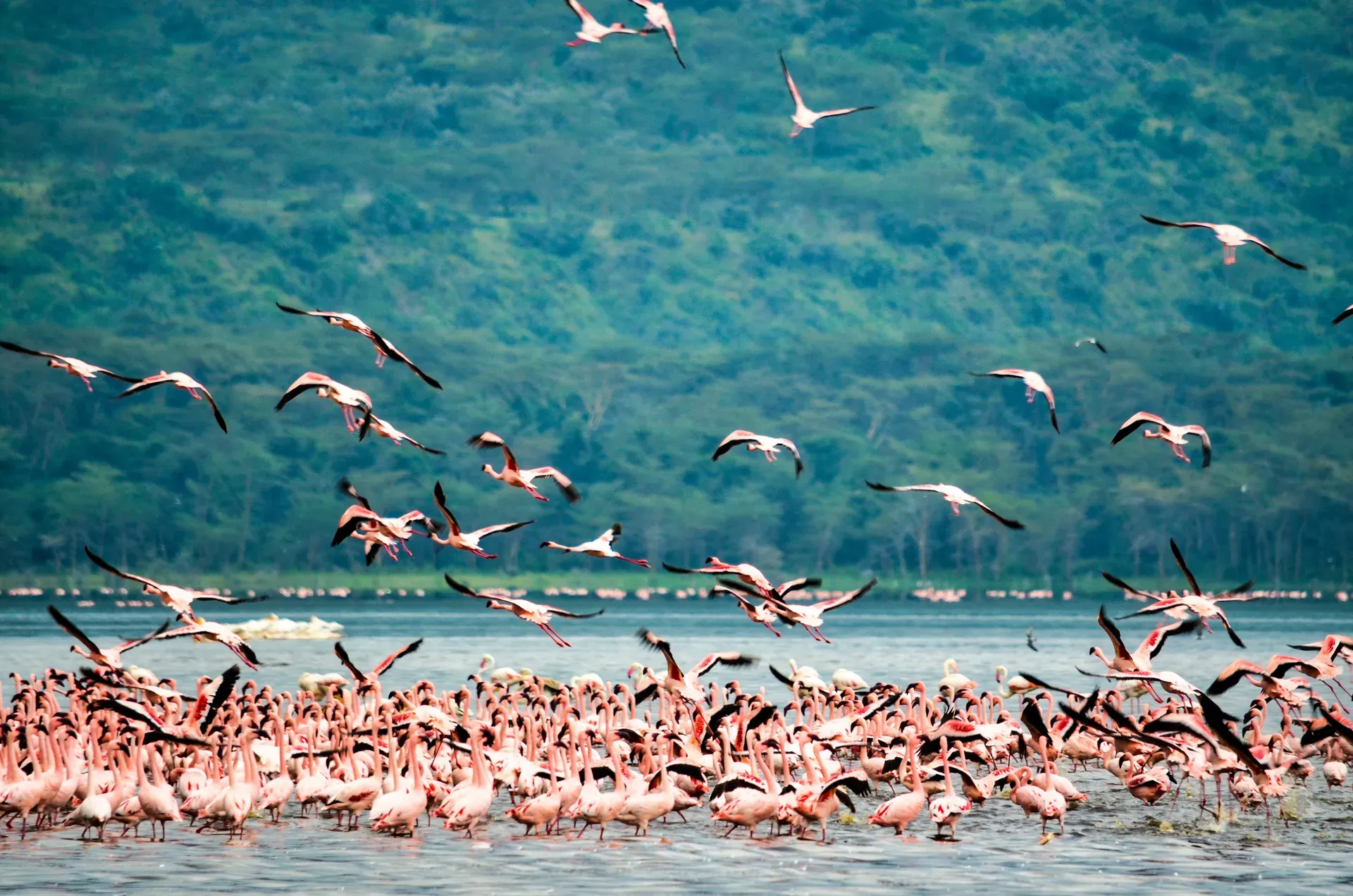
Lake Nakuru National Park charges per-person conservation fees and opens its gates daily from 6:00 AM to 6:00 PM. Foreign visitors pay USD 90 per adult per day, with payment handled cashless through the KWS eCitizen portal.
Lake Nakuru National Park opens every day of the year from 6:00 AM to 6:00 PM East Africa Time — there's no low-season reduction or weekly closure. Only visitors spending a night inside the park may remain past 6:00 PM. The one irregularity is flooding: rising lake waters have periodically shut the Main Gate, so confirm current gate status with KWS before you travel.
Swipe to see more
| Day | Hours | Note |
|---|---|---|
| Monday–Sunday | 06:00–18:00 | Gates open at 6:00 AM sharp and close at 6:00 PM unless you're staying overnight inside the park. Entry is still allowed on free-entry days, with normal gate check-in. |
<p>No public or religious holidays close the park — it runs the same 6:00 AM to 6:00 PM schedule through Christmas, Easter and every Kenyan national holiday. The one date to circle is World Tourism Day: entry was free at all KWS parks on 27 September 2025, and a similar free day is set for 28 September 2026. Expect crowds of local residents on those days. Fees are otherwise flat year-round, with no high-season pricing.
Entry to Lake Nakuru National Park costs USD 90 per non-resident adult per day (USD 45 for children and students), effective 1 October 2025. Citizens and residents of Kenya and East Africa pay far less — KES 1,500 for an East African adult, KES 2,025 for a Kenya resident — and the fee is flat year-round, with no high-season surcharge. Paying is cashless through the KWS eCitizen portal, and your vehicle pays separately (KES 600/day for under 6 seats).
Swipe to see more
| Category | Price | Note |
|---|---|---|
| Non-resident adult | USD 90 | Per person, per day; passport must match the fee category you select on eCitizen |
| Non-resident child/student (3–17) | USD 45 | Half the adult fee; children under 3 enter free |
| African citizen adult (non-East African) | USD 50 | Per person, per day |
| African citizen child (non-East African) | USD 25 | Per person, per day |
| East African citizen adult | KES 1,500 | Per person, per day; proof of citizenship required at the gate |
| East African citizen child/student | KES 750 | Per person, per day |
| Kenya resident adult | KES 2,025 | Per person, per day; residence permit or ID must match the fee category |
| Kenya resident child/student | KES 1,050 | Per person, per day |
| Vehicle entry (under 6 seats) | KES 600/day | Charged on top of per-person fees; larger vehicles scale up to KES 5,000/day |
| Children under 3 | Free | Applies to all fee categories |
Entry to all KWS parks, including Lake Nakuru, was free on World Tourism Day (27 September 2025), and a similar free day has been announced for 28 September 2026 — expect big local crowds, and note that free days still require normal check-in at the gate.
Planning your visit to Lake Nakuru? Find tours with free cancellation and skip-the-line options.
View All ToursThe best time to visit is the long dry season, June to October, when wildlife concentrates near the water, vegetation thins out, and the tracks stay in good condition — January to February runs a close second. Birders should target October to April, when Palearctic migrants swell the park's roughly 450 resident species. Avoid April and May, when the long rains turn the circuit into a slog.
Swipe to see more
| Period | Crowd Level | Recommendation |
|---|---|---|
| Early morning (06:00–08:00) | Low | Gates open at 6:00 AM sharp and the park is nearly empty, with predators still active in the ~10°C cool — this is the window for photographers and anyone serious about sightings. |
| Mid-morning (08:00–11:00) | Moderate | Nairobi day-trippers (about 3 hours away by road) begin arriving, so expect more vehicles at Baboon Cliff and the shoreline tracks — still a fine time for first sightings. |
| Midday (11:00–15:00) | High | The busiest stretch, with daytime highs of 20–25°C and animals retreating to shade; suits families on the standard full-day itinerary who can picnic at the viewpoints. |
| Late afternoon (15:00–18:00) | Moderate | The second-best wildlife window of the day — Baboon Cliff delivers layered landscapes as the sun drops, and day-trippers head out before the 6:00 PM gate closure. |
Plan on a half-day — roughly 4–6 hours covers the main circuit of lakeshore, Baboon Cliff, Makalia Falls and the rhino areas. That's enough for most visitors, and it's why the park is such a popular day trip from Nairobi, 156 km away. A full 6 AM to 6 PM day with picnics at the viewpoints is the standard guided itinerary; self-drivers can compress the loop into four hours if roads are dry.
Buy entry through the KWS eCitizen portal (kwspay.ecitizen.go.ke) before you travel — it's cashless only, taking M-Pesa, bank transfer, or card. The fee category you pick must match the ID or passport you show at the gate, so carry the exact document. Fees are flat year-round, so there's no off-season discount to wait for.
Gates open at 6:00 AM and close at 6:00 PM sharp — late arrivals get turned away, and evening arrivals are a real risk if Nairobi highway congestion stretches your drive past three hours. Predators are still active in the first cool hour, and the lake mirrors the sky before the breeze picks up. Late afternoon is the second-best window; Baboon Cliff gives you layered landscapes as the sun drops.
Come from Nairobi via Lanet Gate — it skips Nakuru town traffic and connects straight to the highway. Nderit Gate in the south suits arrivals from Elementaita or the Maasai Mara. Check with KWS before you travel, because flooding has periodically closed the Main Gate entirely and diverted traffic to the other two.
KWS runs a free-entry day each year around World Tourism Day — 27 September 2025, with the next announced for 28 September 2026. Unless you want to share the park circuit with large local crowds, avoid that date. Any regular weekday in the June-to-October dry season gives you thin vegetation, animals concentrated near water, and passable tracks.
At 1,754 m the park is cold at dawn — around 10°C — even when midday hits 23–25°C, so bring a fleece for the 6 AM entry. Wear khaki or olive; the alkaline dust is white-grey and shows instantly on black clothing. And don't build the trip around flamingos: the million-strong flocks of 2006 have dispersed to Bogoria and Elementaita, so treat the rhinos and the other 440-plus bird species as your headline sightings.
Non-residents pay USD 90 per adult and USD 45 per child or student per day, effective 1 October 2025. East African citizens pay KES 1,500 (adult) and KES 750 (child), while Kenya residents pay KES 2,025 and KES 1,050. Vehicle entry is separate — KES 600 per day for vehicles with fewer than 6 seats.
The park opens daily at 6:00 AM and closes at 6:00 PM East Africa Time, unless you're staying overnight inside the park. Arriving right at 6:00 AM is the best move: predators are still active in the cool hours and the light over the lake is excellent for photography. Late afternoon is the second-best window.
Payment is cashless through the KWS eCitizen portal (kwspay.ecitizen.go.ke), which accepts M-Pesa, bank transfer, and cards. Your selected fee category must match the ID or passport you show at the gate, so carry the right document. KWS customer service is on 0800 597 000 or +254 726 610 509.
Use Lanet Gate if you're coming from Nairobi — it avoids Nakuru town traffic and connects directly to the highway. Main Gate is 4 km from Nakuru town and suits anyone staying there, while Nderit Gate in the south works for arrivals from Elementaita or the Maasai Mara. Check with KWS before you travel, because flooding has periodically closed the Main Gate and pushed traffic to Lanet and Nderit.
Yes — KWS runs a free-entry day each year around World Tourism Day. Entry to all KWS parks was free on 27 September 2025, and a similar free day is scheduled for 28 September 2026. Expect crowds, since these days are popular with local residents, and you'll still need to check in normally at the gate.
Yes — the park is 156 km northwest of Nairobi on the A104, roughly 2.5–3.5 hours depending on traffic, making it one of Kenya's most popular day-trip safaris. A half-day circuit of 4–6 hours covers the lakeshore, Baboon Cliff, Makalia Falls, and the rhino areas; a full day from 6 AM to 6 PM with picnics at the viewpoints is the standard guided itinerary. Gates close at 6:00 PM sharp, so don't plan an evening arrival.
Children aged 3–17 pay half the adult fee — USD 45 for non-residents, for example — and those under 3 enter free. The park is one of Kenya's best introduction-to-safari options for kids: it's compact, fenced, and animals like zebra, buffalo, and baboons show up quickly. Keep children inside the vehicle with doors closed at all times, especially around the baboon troops at viewpoints.
Browse verified tours with free cancellation and instant confirmation.
Find Tours