About All Tours Private ToursSafari ToursJeep ToursFull Day ToursMasai Mara Tours Directions Hours & Fees Guides
Find Tours 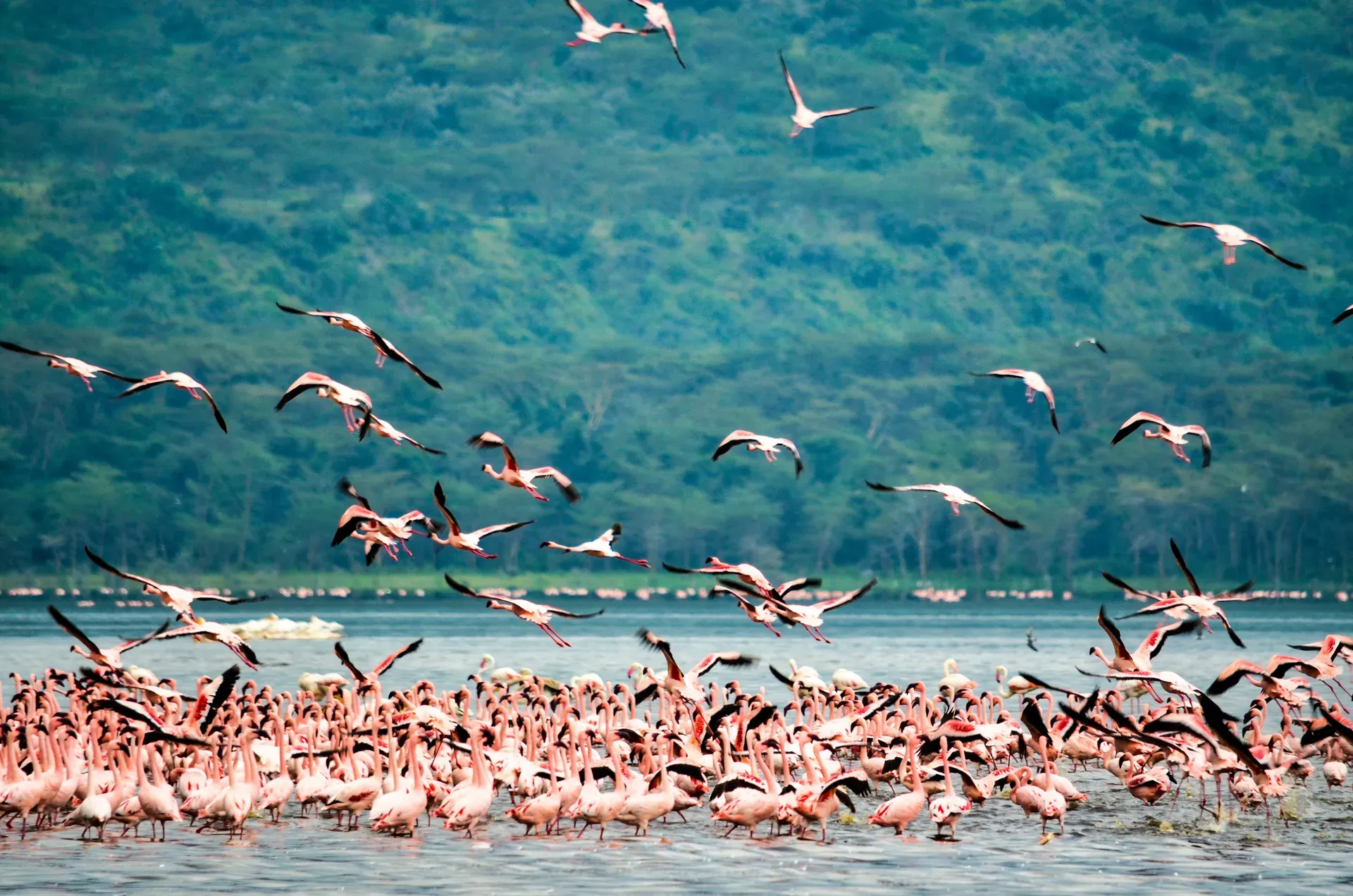
Lake Nakuru is a shallow alkaline lake on Kenya's Rift Valley floor, 156 km northwest of Nairobi, ringed by a 188 km² national park. It holds Kenya's first government-managed rhino sanctuary, roughly 450 bird species, and a lake that once turned pink with over a million flamingos.
Lake Nakuru is a shallow, semi-alkaline lake on the Rift Valley floor, 156 km northwest of Nairobi and just 4 km from Nakuru town, wrapped in a fenced 188 km² national park. The lake averages 0.3 m deep and never exceeds 1.8 m, so its surface swells and shrinks between 5 and 45 km² depending on rainfall. Roughly 450 bird species have been recorded here, from African fish eagles and Goliath herons to pelicans and pied kingfishers, and in January 2006 a KWS survey counted 1,347,063 flamingos on the water.
The park's conservation record is unusually dense for its size. It became a Ramsar wetland on 5 June 1990, and in 2011 UNESCO inscribed it as part of the 'Kenya Lake System of the Great Rift Valley' alongside Lakes Elementaita and Bogoria. In 1987 it was Kenya's first government-managed rhino sanctuary, and it still holds one of the country's largest black rhino concentrations plus around 70 southern white rhinos. There are no elephants inside the fence, but lion, leopard, buffalo and both rhino species make four of the Big Five in an area you can drive across in a morning.
That compactness is the draw. A half-day circuit covers the lakeshore flats, Baboon Cliff, Makalia Falls and the rhino zones, which is why it's one of Kenya's most popular day trips from Nairobi. One honest caveat before you book: the million-flamingo 'pink lake' of the old postcards is largely gone. Rising water diluted the algae the birds feed on, and the remaining flocks move between Nakuru, Bogoria and Elementaita. You'll likely see flamingos, often thousands — just plan the trip around the rhinos and raptors instead.
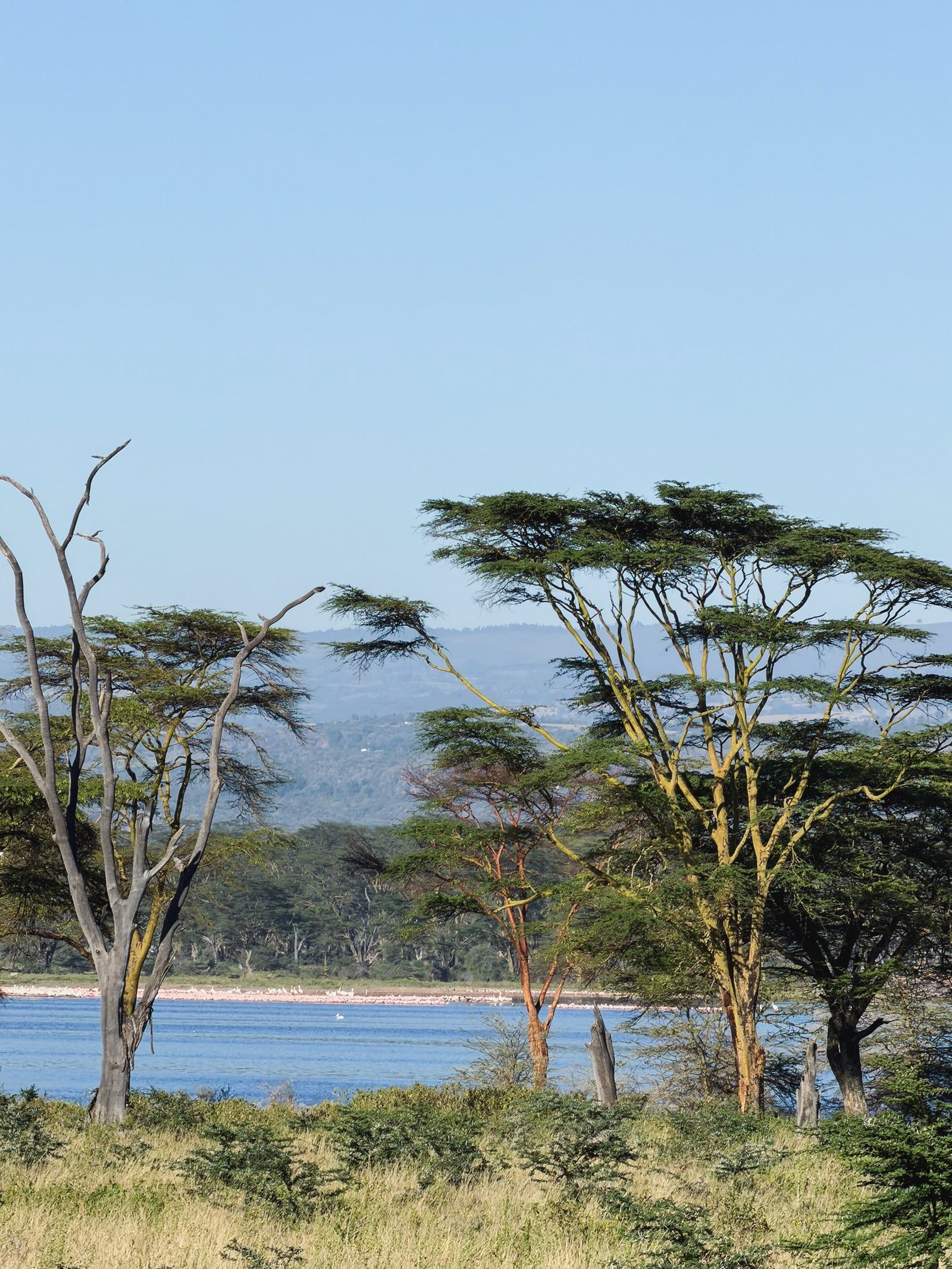
About 10,000 years ago Nakuru, Elementaita and Bogoria formed a single deep freshwater lake on the Rift floor. It dried into three shallow, alkaline remnants. Nakuru, sitting at 1,754 m, is endorheic — water leaves only by evaporation, so dissolved salts concentrate over time and give the lake its chemistry. That shallow, warm, alkaline water turned out to be perfect growing conditions for spirulina algae, the food that drew flamingo flocks numbering over a million.
Formal protection began in 1961, when the southern tip of the lake was designated a bird sanctuary specifically to shield those flamingo populations. In 1964 the sanctuary was extended to the entire lake plus a narrow strip of shoreline. Four years later, in 1968, the lake and its immediate shoreline — about 6,000 hectares — were gazetted as Lake Nakuru National Park. A 1974 expansion, backed by WWF, brought the park to its current 188 km² and added the grasslands, acacia woodlands and rocky escarpments that hold most of the mammals today.
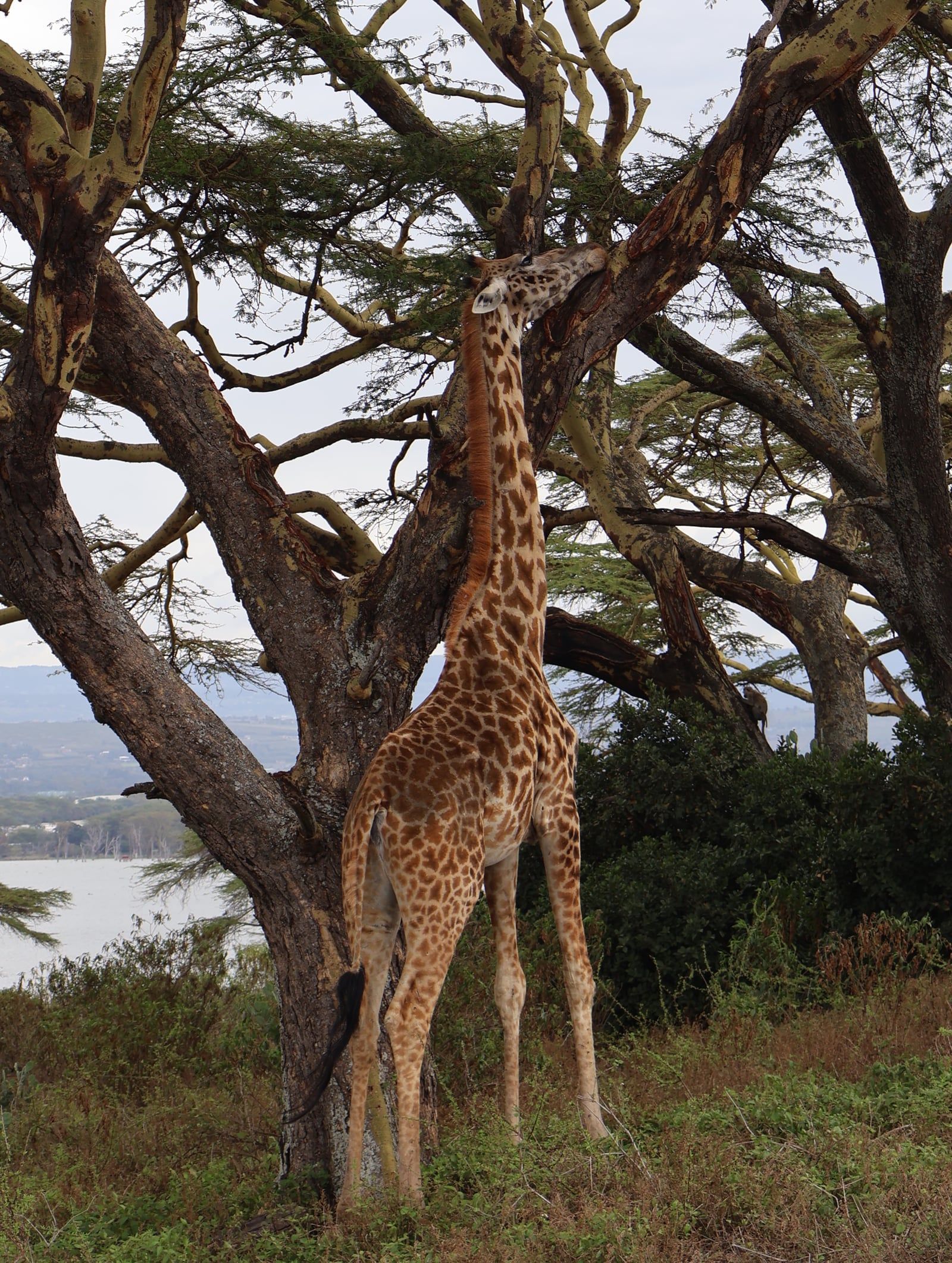
Rothschild's giraffes were relocated here from western Kenya starting in 1977, establishing a population that still grazes the shoreline. An electric perimeter fence went up in 1986, and in 1987 the park became Kenya's first government-managed rhino sanctuary — a direct response to poaching pressure elsewhere in the country. The lake was designated a Ramsar wetland on 5 June 1990, recognizing it as a wetland of international importance.
In 2011 UNESCO inscribed the lake into the 'Kenya Lake System of the Great Rift Valley' World Heritage Site. Then the water came. Between 2010 and 2020 the lake's surface grew from 40 to 68 km² — roughly 37% growth from 2011 to 2021, reaching about 82 km² by 2026 — flooding shoreline habitat, lakeside tracks, park infrastructure and 677 households outside the fence. KWS has periodically closed the flooded Main Gate and rerouted traffic to the Lanet and Nderit gates. The deeper, diluted water also cut the spirulina supply, and the great flamingo flocks dispersed to Bogoria and Elementaita, where most still feed today.
Physically, Lake Nakuru is a study in extremes packed into a small space. The lake sits at 1,754 m on the Rift Valley floor with no outflow, its surface swinging between 5 and 45 km² with the seasons. The surrounding park compresses shoreline flats, grassland, acacia woodland, euphorbia forest and rocky escarpment into 188 km², rising from the water's edge to viewpoints like Baboon Cliff, where you look down over the whole southern plain. Makalia Falls, in the park's south, runs hardest after the April–May and November rains and dries to a trickle outside them. The altitude keeps days at 20–25°C and mornings near 10°C year-round.
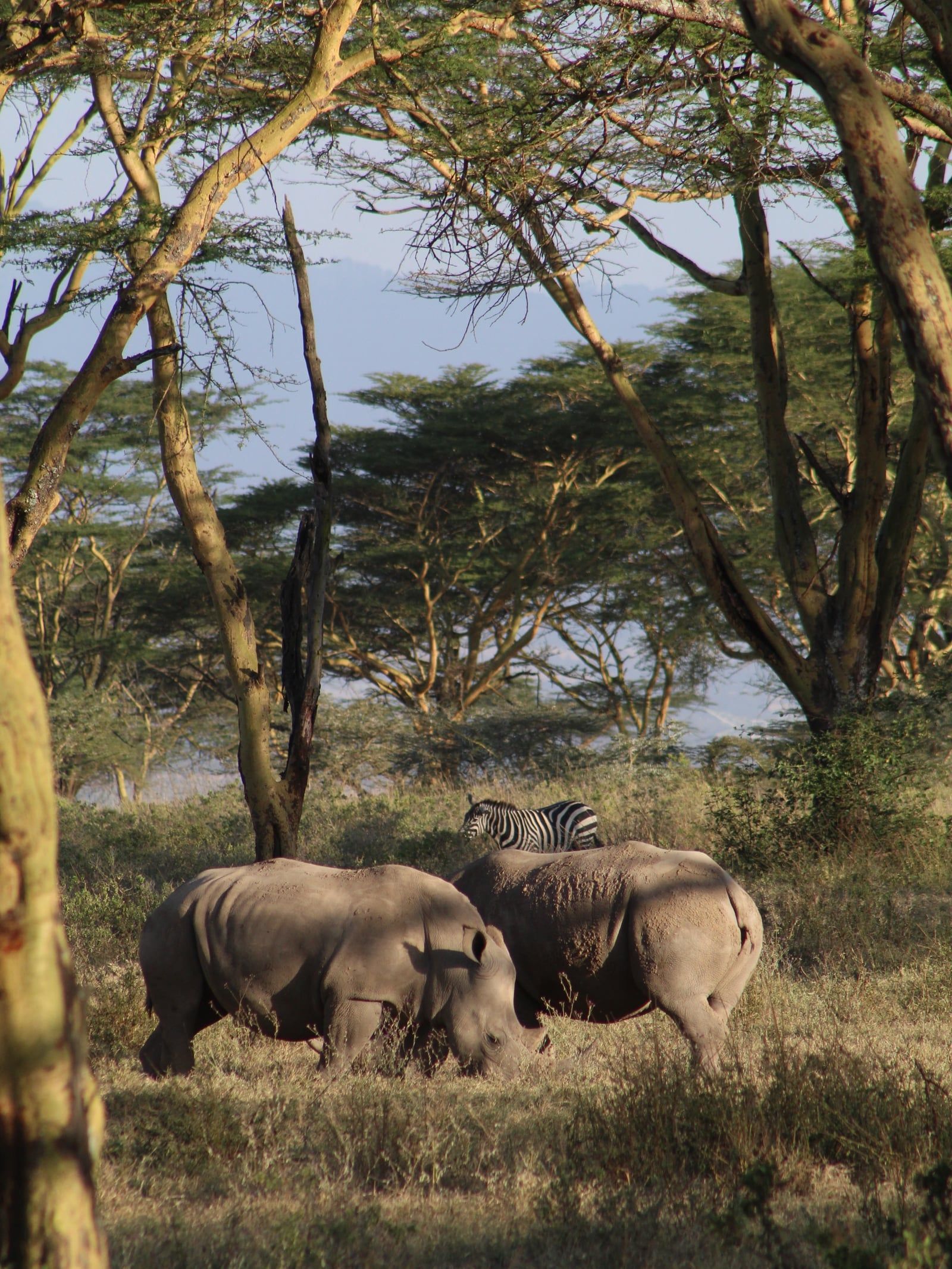
The wildlife is what fills the circuits. Around 70 southern white rhinos graze the shoreline grasslands and 25-plus eastern black rhinos browse the thickets, giving some of the most reliable rhino sightings in East Africa. Rothschild's giraffes, translocated from western Kenya since 1977, browse alongside waterbuck — both Kenyan subspecies occur here — plus zebra, impala, buffalo and hippo. Lions doze in the acacias, spotted hyenas work the plains, and the dense woodlands hold large pythons that sometimes cross the roads or hang from branches. Scan the trees as often as the grass.
For birders the numbers do the talking: roughly 450 species, including Verreaux's eagle over the escarpment, hamerkops along the marsh edges, pelicans and cormorants on the open water, and thousands of little grebes, stilts and avocets on the flats. October to April is peak season, when Palearctic migrant waders arrive. Bring binoculars — the lakeshore, the marshes and the euphorbia forests each hold a different set of birds, and the shoreline tracks in early light are where the good photographs happen.
People have lived beside this lake for a very long time. Hyrax Hill, about 5 km away on the Nakuru–Nairobi highway, holds evidence of Neolithic settlements dating back over 3,000 years — pottery, tools and burial sites from early pastoral communities. British archaeologist Mary Leakey identified the site in the 1920s, and the small museum there now displays the finds. The rock outcrops give views over both the town and the lake; it's an easy one-hour stop on the way in or out.
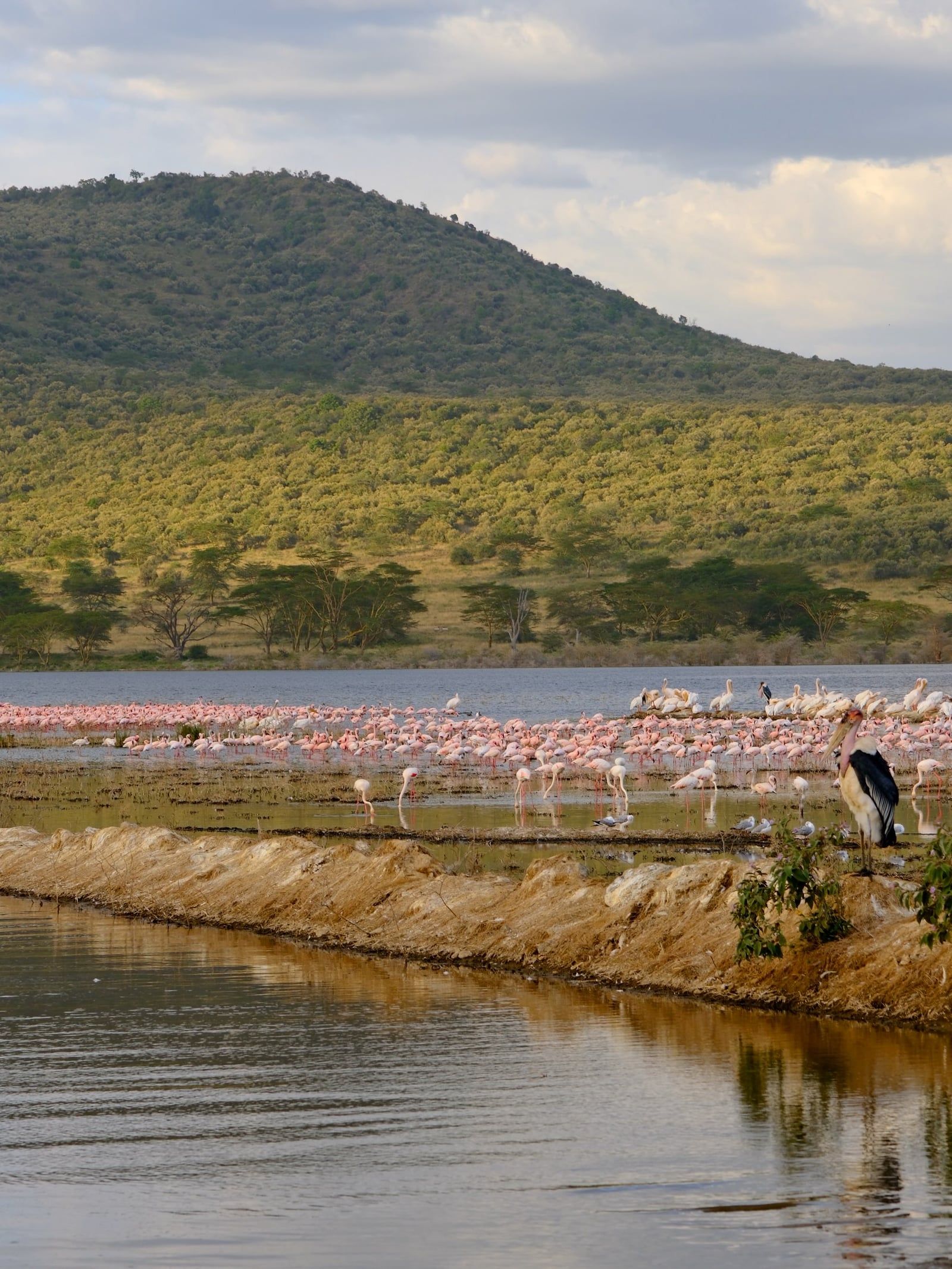
For decades, the flamingo flocks made this one of the most photographed wildlife spectacles in East Africa. A single January 2006 survey put 1,347,063 birds on the water, and the 'pink lake' image spread through Kenyan tourism material worldwide. That fame still shapes expectations — many visitors arrive expecting the historic blanket of pink, which is exactly why rangers and guides now spend as much time explaining where the birds have gone as pointing out the ones that remain.
The lake also directly structures life around it. Nakuru town sits 4 km from the Main Gate, and its hotels, guide services and curio sellers run on park traffic. The rising waters have cut both ways: they displaced 677 local households, while the park's rhino sanctuary and UNESCO status keep visitors coming. Nearby Menengai Crater, a 20–30 minute drive away, carries its own local lore as one of Africa's largest calderas, and the 2011 World Heritage inscription tied Nakuru, Elementaita and Bogoria into a single protected system spanning the central Rift.
A KWS survey in January 2006 counted 1,347,063 flamingos on Lake Nakuru. Today's counts run to tens of thousands, as rising, diluted water reduced the spirulina algae they feed on.
The park is fully fenced and has no elephants, yet still delivers four of the Big Five: lion, leopard, buffalo and both black and white rhino.
Around 10,000 years ago Nakuru, Elementaita and Bogoria formed a single deep freshwater lake, which dried into the three shallow alkaline lakes seen today.
Rothschild's giraffes have been relocated here from western Kenya since 1977, and the park now holds one of the species' important populations.
Between 2011 and 2021 the lake's surface expanded from roughly 43 to 68 km², flooding park infrastructure and 677 households and periodically closing the Main Gate.
The dense woodlands host large pythons that are regularly seen crossing roads or dangling from trees — a sighting most safari parks can't offer.
KWS offered free entry to all parks on World Tourism Day, 27 September 2025, with a similar free day announced for 28 September 2026 — expect big local crowds.
Yes, but far fewer than before. The January 2006 survey recorded 1,347,063 flamingos, while recent counts run to tens of thousands, with flocks of roughly 10,000–30,000 moving nomadically around the Naishi plains and neighboring lakes. Rising water diluted the algae they feed on, so many birds now feed at Bogoria and Elementaita instead. You'll likely see flamingos, but not the historic 'pink blanket'.
No — the park has four of the Big Five: lion, leopard, buffalo and both black and white rhino. There are no elephants inside the fully fenced park. Rothschild's giraffes, zebras, waterbuck, hippos, hyenas and large pythons round out the sightings, and the park's small size means encounters come quickly.
Non-residents pay USD 90 per adult and USD 45 per child or student per day (effective 1 October 2025). African citizens from outside East Africa pay USD 50/25, East African citizens KES 1,500/750, and Kenya residents KES 2,025/1,050. Vehicle entry — KES 600 per day for vehicles under 6 seats — is charged separately.
The park is 156 km northwest of Nairobi on the A104 highway, about 2.5–3.5 hours depending on traffic. Buses and matatus take around 3 hours to Nakuru town, and the Main Gate is only 4 km from the town center. Highway congestion and roadworks around Rironi can stretch the drive, so leave early.
Yes. Gates open at 6:00 AM and close at 6:00 PM, and a self-drive circuit of the lake, Baboon Cliff and Makalia Falls fits comfortably in a day. Observe the 40 km/h speed limit, stay on designated tracks, and budget for per-person entry plus the KES 600 vehicle charge. Take a 4x4 in the rainy months.
Yes. The park lies in a Rift Valley malaria zone, so take prophylaxis as advised by your doctor, use repellent, and wear long sleeves at dawn and dusk. The 1,754 m altitude makes risk lower than at Kenya's lowland parks, but it isn't zero.
Use Lanet Gate if arriving from Nairobi — it skips Nakuru town traffic and connects directly to the highway. Main Gate (4 km from town) suits visitors staying in Nakuru, while Nderit Gate in the south works for arrivals from Elementaita or the Maasai Mara. Check with KWS before travelling, because flooding has periodically closed the Main Gate.
Pay through the official cashless KWS eCitizen portal (kwspay.ecitizen.go.ke), which accepts M-Pesa, bank transfer and cards. Your selected fee category must match the ID or passport you present at the gate, so carry your passport. KWS customer service is on 0800 597 000 or +254 726 610 509.
No. Swimming in rivers and lakes is illegal in Kenya's national parks, and Nakuru's alkaline water would be unpleasant anyway. The lake is also a protected feeding ground for birds — enjoy it from the shoreline tracks and viewpoints.
Yes — KWS runs an annual free-entry day around World Tourism Day. Entry to all KWS parks was free on 27 September 2025, with a similar day announced for 28 September 2026. Expect crowds, as the free days are popular with local residents. Otherwise, fees are flat year-round with no seasonal pricing.
Browse verified tours with free cancellation and instant confirmation.
Find Tours